Reelex
REELEX’s Long and Winding Road from WWII to Patterson
While Putnam County is often seen as a bucolic community, it’s also home to manufacturing, including REELEX Packaging Solutions at Robin Hill Corporate Park in Patterson.
The company makes machines that help cable and wire manufacturers wind and package their product in a way that results in zero twist, tangles or hassles during payout or installation. The REELEX coil is a patented method of precision-winding filamentary products like fiber optic cables, copper cables, telephone wire, conduit and more into a figure-eight coil.
Without a REELEX machine, a customer like Belden, a global leader in network, connectivity and cables for many industries, would be hard-pressed to find another source that can provide twist-free, tangle-free winding and packaging solutions that installers prefer.
“Our secret sauce is in the math,” says President and CEO David Gerhart, a mechanical engineer specializing in industrial automation. “Making a coil requires precise control so it doesn’t knot up, twist, or tangle.”
As a value added for its more than 180 licensees, the privately held REELEX provides customers with packaging templates that use more affordable, durable and sustainable materials like cardboard as opposed to using wooden or plastic reels.
Licensees also benefit from having access to the Co-Creation Lab where they work with REELEX engineers to produce new innovations.
Transformation of Cable Winding
From its 55,000-square-foot high-tech machine shop and warehouse, REELEX has quietly been transforming the cable winding industry in 22 countries worldwide for decades.
“With 100 percent certainty, the wires that are in your home heating/AC thermostat came out of a REELEX box,” according to Gerhart.
The CEO is animated as he recalls REELEX’s history, starting with World War II, especially noting its journey from a New York City garage to Putnam County.
“We have an interesting background,” says Gerhart, a history buff. “When I joined the business five years ago, I went through the files and board minutes from 1962 on.”
Culling through archives, Gerhart created a timeline of how REELEX operated when it was founded as Windings in 1958. According to Gerhart, it’s unique for a company this size to have maintained copious notes in good condition for more than 65 years. “My predecessors were really good at taking notes,” he says of the typed meeting minutes. He also found renderings of the first machines, restoring them into framed artwork for office walls.
Roots in World War II
As the story goes, the idea for Windings was hatched when two New York City inventors – Walter Taylor and Jim Newman – set out to save the lives of American soldiers in the war. Taylor first conceived the idea as an improved way for combat troops to lay field telephone wire while having their hands free to hold a gun. As a soldier advanced, the wire would dispense from a figure-eight coil in a canvas container attached to his belt.
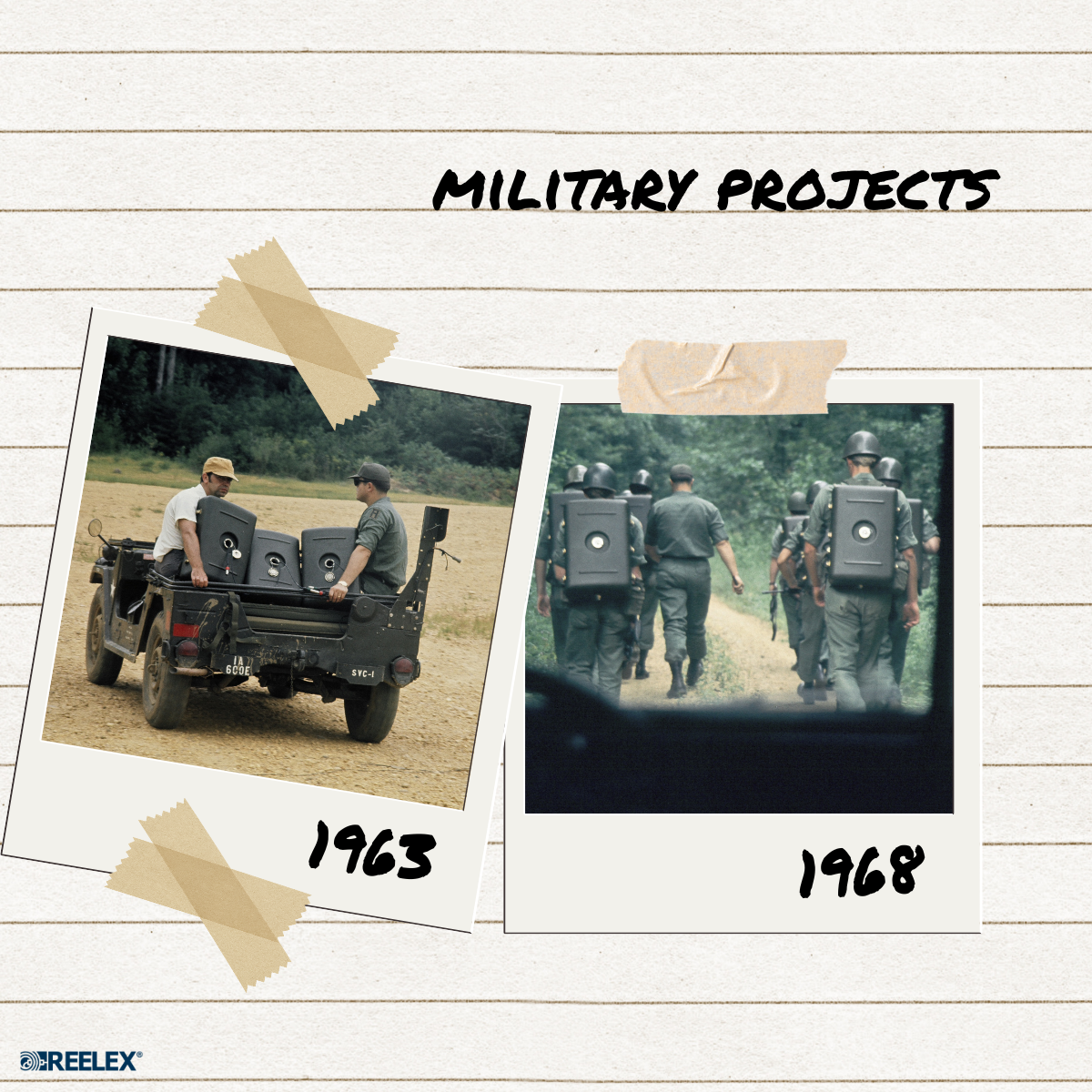
After World War II, they created a figure-eight winding machine and received a patent so Taylor could start selling his technology. In 1963, during the Vietnam war, the company was contacted by the US Military to develop a tangle and twist-free battlefield cable dispensing system. In 1968, they developed a “field pack” backpack that contained up to 500 meters of communication cables and allow infantrymen to rapidly deploy cables across the battlefield.
In the 1970s, REELEX focused on commercial opportunities and signed its first licensee, Belden, in 1973. REELEX really took off in the 1980s as the “tangle-free box” became more readily available.
Read the full company history on the REELEX website.
In 1993, the private company was sold and moved to Patterson, a location that allowed for expansion.
From its days as a family business, REELEX still maintains its culture of tight knit, highly collaborative teamwork. “In my 35-year career, I’ve never seen this level of collaboration,” explains Gerhart.
A Culture of Change
In his five years at REELEX, Gerhart has brought streamlining and efficiency to his team. For example, a machine that used to take four to six months to build now can be done in four weeks, he says.
Gerhart and his three-person sales team are seeking ways to embrace new markets in fiber optic cable. “The copper cable business has been stable but not growing. There are new markets to penetrate,” he says.
With a goal of signing on two to three new licensees each year, Gerhart says REELEX is poised for new growth.
“This is a nice size facility, the location is good, and it would be hard to replicate,” says Gerhart. “At the end of the day, we’re here because of the people. This community offers a workforce grounded in strong values and a work ethic that aligns with who we are and how we operate.” He is also proud of the number of veterans that work at REELEX.
Gerhart says they’re always looking for machinists, engineers and new talent that can join the team.
He also enjoys connections he has made through Westchester business councils and the Putnam Economic Development Corporation.
Those connections have opened opportunities for REELEX employees to advance their professional development. Earlier this year, two MIAP apprentices earned their SACA Gold Certification from Council of Industry. And in 2025, Tom Briggs, head of manufacturing, completed his certificate in manufacturing leadership from Council of Industry’s Manufacturer’s Association of the Hudson Valley.
It also helped facilitate a visit from Congressman Mike Lawler who came for a tour and discussed U.S. manufacturing in New York.